Are Life Insurance Payouts Taxable? What the IRS Says

Short answer: no, almost never. If you are asking are life insurance payouts taxable because a check is on its way, you can breathe. The death benefit itself is not income. There are three exceptions, and each one is narrow. This page explains them in plain words so you know what to expect at tax time.
The rule: life insurance payouts are not taxable income
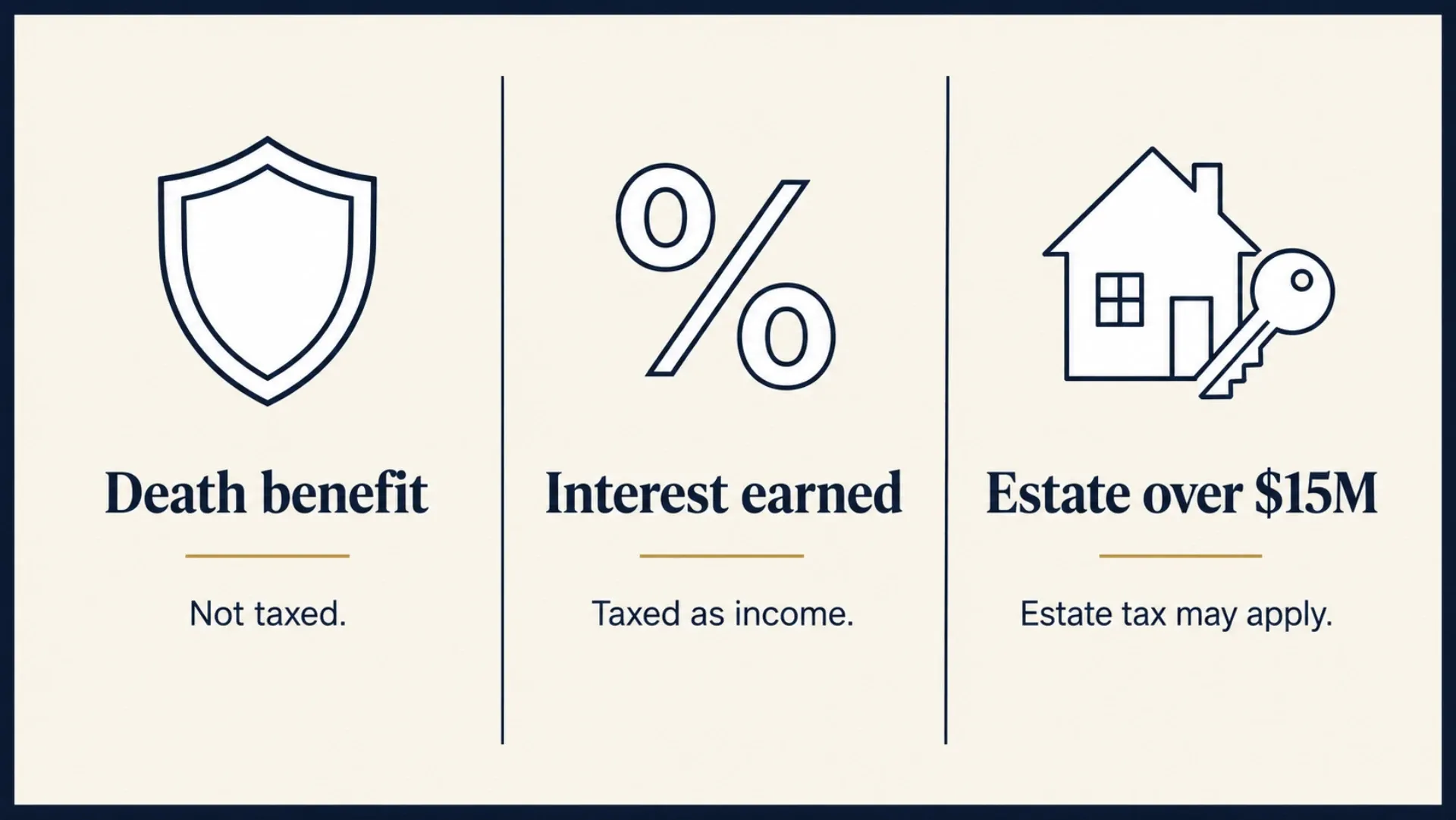
The IRS says it directly. Life insurance proceeds you receive as a beneficiary because the insured person died are not included in your gross income, and you do not report them.
That applies to a private term policy, a whole life policy, employer group life, and the VA programs, SGLI, VGLI, and VALife. A $500,000 lump sum is $500,000 to you. No federal income tax. No state income tax either, since states follow the same treatment.
You will not get a 1099 for the benefit itself. You may get one for something else, which brings us to the exceptions.
Exception one: interest is taxable
This is the one that catches families.
If the insurer holds the money for a while and pays you interest on it, that interest is ordinary income. The IRS puts it in one sentence: any interest you receive is taxable, and you should report it as interest received.
Where does interest show up?
A claim that took time. Many states require the insurer to pay interest from the date of death or the date of the claim if payment is delayed. That interest comes with a 1099-INT.
A retained asset account. If you leave the money with the insurer in a checkbook-style account (the VA programs call theirs the Alliance Account), the balance earns interest. The principal is still tax-free. The interest is not.
An installment option. If you choose to be paid over years instead of at once, each payment is part principal and part interest. The principal share is tax-free. The interest share is income.
The amounts are usually small next to the benefit. A $500,000 benefit that earned $1,200 of interest before you moved it means $1,200 of taxable income, not $501,200.
Exception two: installments and the "proportionate part" rule
If you take the money as a series of payments, Publication 525 tells you how to split each one. A proportionate part of each payment is a return of the death benefit and is not income. The rest is interest and is income.
The insurer does the math and reports the interest portion to you each year. Keep the first year's statement, because it shows the split the insurer is using.
For the VA programs, the 36 equal monthly payments option works the same way. The benefit is tax-free; the interest the insurer adds to spread it over three years is not.
Exception three: estates large enough to owe estate tax
This one applies to very few families, but it is the reason lawyers ask who owns a policy.
The death benefit is not income to you, but it can be counted as part of the deceased person's estate if they owned the policy. Estate tax is a separate tax, paid by the estate before anything is distributed.
For 2026, the federal estate tax exemption is $15 million per person, made permanent by the 2025 tax law and indexed for inflation after that. An estate below that amount owes no federal estate tax, life insurance included. Some states have their own estate or inheritance tax with lower thresholds, so a family with a large estate in one of those states should ask a tax professional.
If an estate is anywhere near those numbers, the standard fix is to have the policy owned by someone other than the insured, often a trust. That is planning done years before a death, not a claim-time decision, and it belongs with an estate attorney. Start with how veterans should name life insurance beneficiaries, which covers the designation side.
A fourth case, mostly for policies that changed hands
If a policy was sold or transferred to someone for money, the buyer's tax-free amount is limited to what they paid plus premiums they paid afterward. The IRS calls this the transfer-for-value rule. It rarely touches a veteran's family policy, and it never touches SGLI or VGLI, which cannot be sold. It matters when a business bought a policy on a partner, or when someone sold a policy in a life settlement.
What about the premiums, and the payout while alive?
Two related questions come up on the same search.
Premiums are not deductible for an individual policy. You pay them with after-tax money.
Living benefits paid while the insured is alive, such as an accelerated death benefit for a terminal illness, are generally tax-free under the same rules as a death benefit. See living benefits explained.
Cash value withdrawals from a permanent policy can be taxable above what was paid in. We do not place permanent products, but if you hold one, the insurer's annual statement shows the cost basis.
What the beneficiary should keep for tax time
Keep the claim settlement letter, which states the benefit amount and the date paid. Keep any 1099-INT the insurer sends. If you took installments, keep each year's statement. That is the entire file. The benefit does not go on your return; the interest does, on the same line as bank interest.
Frequently asked questions
Are life insurance payouts taxable to the beneficiary?
No. The death benefit is not gross income and is not reported on your tax return. Only interest the insurer pays you on top of the benefit is taxable.
Are installment payments from a policy taxable?
Part of each installment is a tax-free return of the benefit and part is taxable interest. The insurer reports the interest portion to you each year.
Is SGLI or VGLI taxable?
No. SGLI and VGLI death benefits are life insurance proceeds and are not income to the beneficiary. Interest earned in an Alliance Account, or the interest built into the 36-payment option, is taxable.
Do you pay taxes on life insurance over a certain amount?
Not income tax. Large benefits can count toward the deceased person's estate, and federal estate tax only applies to estates above the exemption, which is $15 million per person in 2026. Some states set lower thresholds for their own estate or inheritance taxes.
Will I get a 1099 for a life insurance payout?
Not for the death benefit. You may receive a 1099-INT for interest, or a 1099-R in unusual cases such as certain policy transfers.
Your next step
Get the free guide, "Leaving the Service: Your Life Insurance Decision Guide". It walks through the coverage choices that decide how much reaches your family in the first place. Or take the quiz, Which Coverage Fits You?
This page is educational and is not tax advice. A tax professional can apply these rules to your return.
Sources: IRS, Life Insurance and Disability Insurance Proceeds FAQ (irs.gov/faqs/interest-dividends-other-types-of-income/life-insurance-disability-insurance-proceeds); IRS, Publication 525, Taxable and Nontaxable Income, life insurance proceeds and installments (irs.gov/publications/p525); Morgan Lewis, IRS Announces Increased Gift and Estate Tax Exemption Amounts for 2026 (morganlewis.com/pubs/2025/10/irs-announces-increased-gift-and-estate-tax-exemption-amounts-for-2026); VA, SGLV 8283 Claim for Death Benefits, payment options (benefits.va.gov/insurance/forms/sglv-8283-bene.pdf); NAIC, Retained Asset Accounts and Life Insurance (content.naic.org/article/consumer-insight-retained-asset-accounts-and-life-insurance). Accessed September 2, 2026.