How to Find a Lost Life Insurance Policy: Free Searches That Work

Someone has died, you believe there was a policy, and you cannot find it. This is common. People buy coverage, change addresses, switch banks, and never mention it. Here is how to find a lost life insurance policy, in the order that works, using the free tools first. Most searches that succeed do so within the first three steps.
Step one: the paper and the accounts
Before any database, look where the evidence already is.
Bank and credit card statements. A premium is a recurring charge, monthly, quarterly, or annual. Scan two years of statements for an insurer's name or a payment to an agency. An annual premium can hide in a single month, so go back at least a year.
Mail, email, and the safe deposit box. Insurers send annual statements, rate notices, and beneficiary confirmations. Search email for "policy," "premium," and "beneficiary."
Tax returns. A 1099-INT from an insurer, or a dividend from a mutual insurer, points straight to a policy.
The employer. Group life through work is the most commonly forgotten coverage. Call the HR or benefits office of the last employer, and of any employer the person retired from, and ask whether a group life or retiree life benefit was in force.
The people who would know. The family attorney, accountant, financial advisor, and insurance agent for the home or car. Agents often placed the life policy too.
Step two: the VA, for any veteran
If the person served, check the VA programs before anything else. SGLI ends 120 days after separation, so a veteran who left years ago will not have it, but many converted to VGLI and kept paying, and a veteran with a service-connected rating may have VALife.
Call the Office of Servicemembers' Group Life Insurance at 1-800-419-1473 and ask whether a VGLI policy was in force. For VALife and the older VA policies (S-DVI and the World War II era programs), call the VA Insurance Center at 1-800-669-8477. Have the veteran's full name, date of birth, Social Security number, and a copy of the death certificate ready.
Veterans also carried private coverage, so keep going after the VA check.
Step three: the NAIC Life Insurance Policy Locator
This is the tool to use when the paper trail runs out. The National Association of Insurance Commissioners runs a free, secure request form. You enter the deceased person's details, and the request goes to every participating life insurer, which searches its own records. If a company finds a policy and you are the beneficiary or have legal authority, it contacts you directly.
Three things to know so you do not misread the silence.
It takes time. The NAIC says searches may take 90 business days or more. That is four to five calendar months. Submit it early and keep working the other steps.
No news is the answer. You will not receive a response if there is no match, if you are not the beneficiary, or if you do not have legal authority to access the information.
It works. As of the NAIC's September 2025 update, the locator had handled more than 1.17 million requests, matched more than 611,000 of them, and connected families with $13.18 billion in benefits.
You need the death certificate to submit. Beneficiaries, executors, and legal representatives can file.
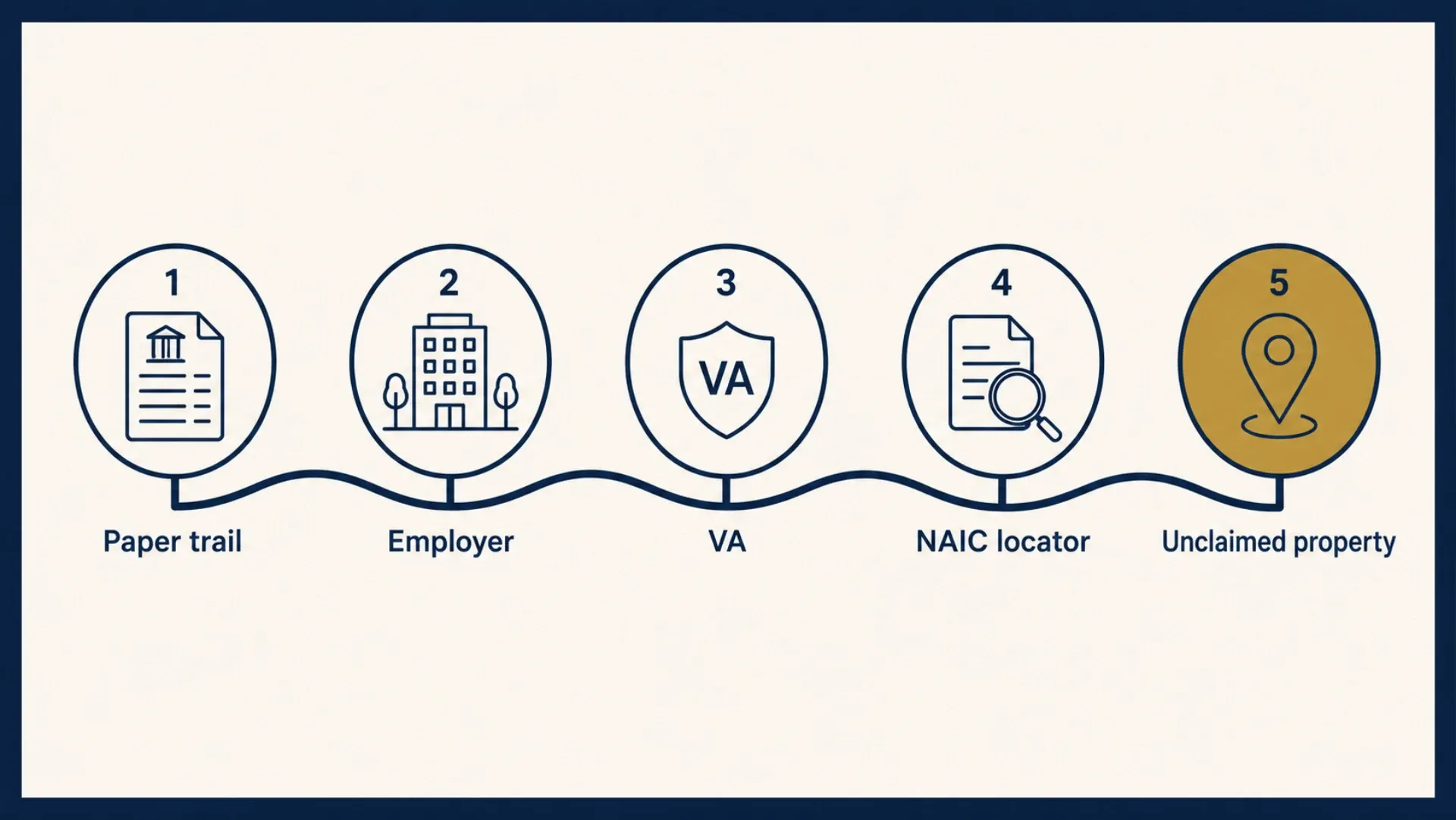
Step four: state unclaimed property
When an insurer knows a policyholder has died but cannot locate the beneficiary, and after a period set by state law, it turns the money over to the state's unclaimed property office. Insurers are also required in most states to check their policies against the Social Security death file, so more benefits reach these offices than they once did.
Search the state where the person lived, and every state they lived in before. The official multi-state search is MissingMoney.com, run by the state administrators' association. Each state also has its own site. Searches are free, and the money never expires; the state holds it until a rightful owner claims it.
Step five: the paid option
MIB, the industry's underwriting data exchange, runs a fee-based Policy Locator Service. It searches records of life insurance applications, not policies, and its database reaches back only to 1996. A match tells you the insurer's name and the application date, and you follow up with the company to learn whether a policy was issued and kept in force. Executors, surviving spouses, and close relatives can request it. Given the cost, use it after the free searches, not instead of them.
When you find the lost life insurance policy
Confirm three things with the insurer: that the policy was in force at death (a lapsed policy pays nothing, and what a lapse means is its own subject), who the named beneficiary is, and what the claim process requires. Then file. Our claim filing guide covers the documents and the VA forms, and are life insurance payouts taxable? covers what happens at tax time.
Do not let this happen to your own family
Every step above exists because someone bought a policy and told no one. The fix takes ten minutes. Write down the insurer, the policy number, the agent's contact, and where the document is kept. Give a copy to the beneficiary and to the person who will handle your estate. Update it when anything changes, including the beneficiary designation, which how veterans should name life insurance beneficiaries explains.
Frequently asked questions
How do I find a lost life insurance policy for free?
Check bank statements, mail, and email for premium payments; call the last employer about group life; call OSGLI or the VA Insurance Center if the person served; submit a request to the free NAIC Life Insurance Policy Locator; and search state unclaimed property at MissingMoney.com.
How long does the NAIC policy locator take?
The NAIC says 90 business days or more. You are contacted only if a participating insurer finds a match and you are the beneficiary or have legal authority.
How do I find out if a veteran had life insurance?
Call the Office of Servicemembers' Group Life Insurance at 1-800-419-1473 for VGLI, and the VA Insurance Center at 1-800-669-8477 for VALife and older VA policies. Then run the same private-policy searches as anyone else, because most veterans also held private coverage.
What is unclaimed life insurance?
A death benefit the insurer could not deliver because it could not find the beneficiary. After a waiting period set by state law, the insurer turns it over to the state's unclaimed property office, where it is held until claimed.
Does a lost policy still pay if premiums stopped years ago?
A term policy that lapsed pays nothing. A permanent policy may have continued on its own cash value for a time, or may have paid-up coverage. The insurer can tell you the status once you find it.
Your next step
Get the free guide, "Leaving the Service: Your Life Insurance Decision Guide". It includes the coverage inventory your family will need one day. Or take the quiz, Which Coverage Fits You?
Sources: NAIC, Life Insurance Policy Locator Tool Helps Consumers Connect with More Than $13 Billion in Benefits, September 30, 2025 (content.naic.org/article/naic-life-insurance-policy-locator-tool-helps-consumers-connect-more-13-billion-benefits); NAIC, Life Insurance Policy Locator (eapps.naic.org/life-policy-locator); MIB, Policy Locator Service FAQs (mib.com/policy_locator_faqs.html); National Association of Unclaimed Property Administrators, MissingMoney.com; VA, Veterans' Group Life Insurance, OSGLI contact (va.gov/life-insurance/options-eligibility/vgli/). Accessed September 2, 2026.