How to File a Life Insurance Claim: A Guide for Veterans' Families

If you are reading this, someone you love has probably just died, and there is a policy with your name on it. This page tells you how to file a life insurance claim without guessing. It covers private policies first, then the VA programs, SGLI and VGLI, which use their own form and their own office. Save it, hand it to whoever is helping you, and work through it in order.
First, find the policy and the company
You cannot file a claim until you know who holds the policy. Look for a policy document, a premium bill, a bank statement showing a monthly draft, or an email from an insurer. The employer's HR office knows about group coverage. The VA knows about SGLI, VGLI, and VALife.
If you cannot find anything, do not stop here. We wrote a separate page on finding a lost or forgotten life insurance policy. It covers the free NAIC locator and the state unclaimed property search.
What you need before you call
Every insurer asks for the same core items. Gather them once.
A certified copy of the death certificate. Not a photocopy. The funeral home usually orders these for you. Order several, because banks, the VA, and Social Security will each want one.
The policy number, if you have it. If you do not, the insured's full name, date of birth, and Social Security number let the insurer find it.
Your own identification and Social Security number, since the payout is reported to you.
The insurer's claim form. Most companies let you start online or by phone and then mail or upload the form. The form asks how you want to be paid, which matters more than it looks. We cover that below.
If the death happened outside the United States, or the cause is still under investigation, the insurer will also ask for the police or coroner's report. Expect that and it will not feel like an obstacle.
The life insurance claim process, step by step
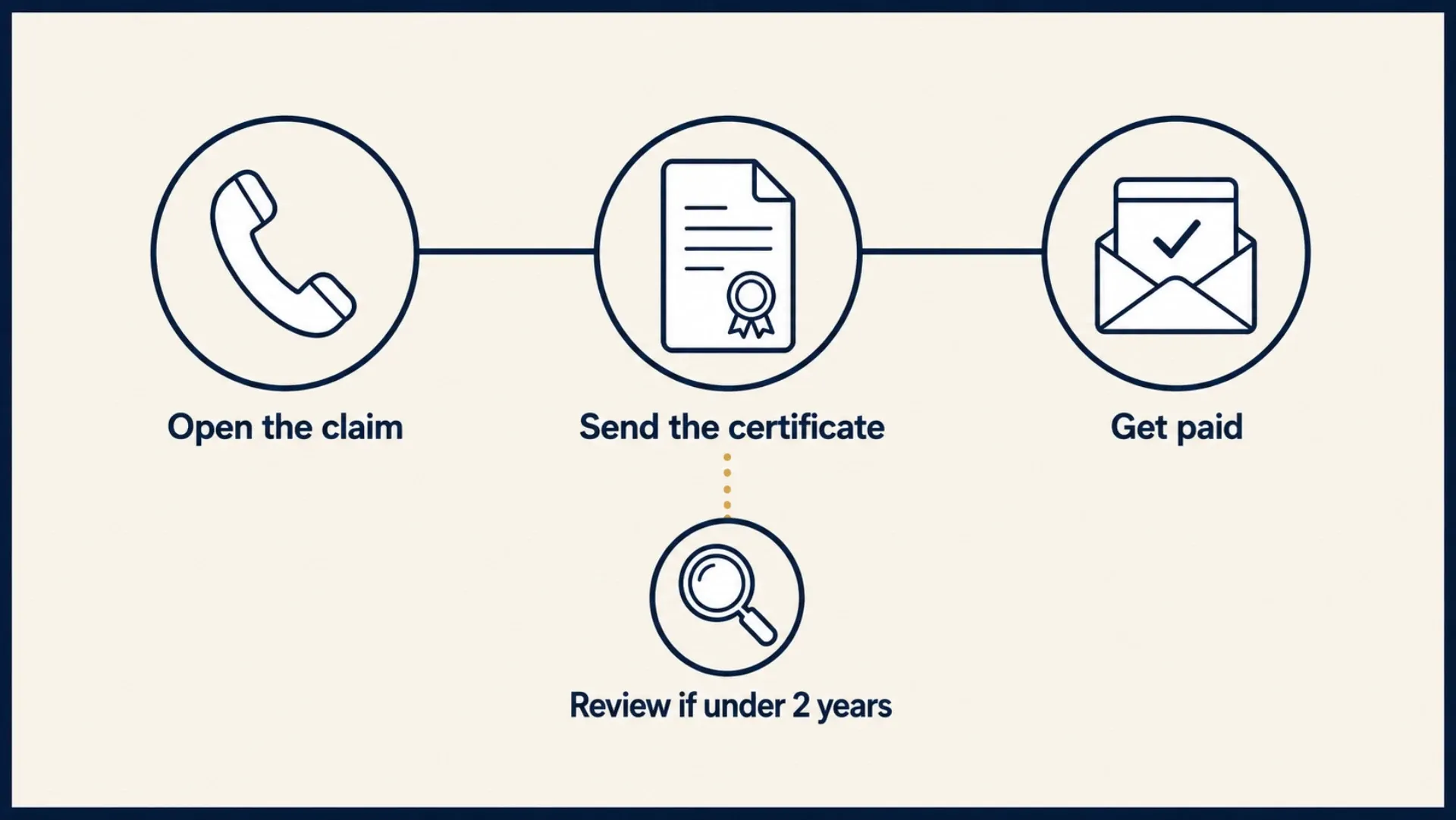
1. Call the insurer and open the claim. Ask for the claims department, give the policy number, and ask them to send the claim packet. Write down the claim number and the name of the person you spoke with.
2. Complete the claimant's statement. Each beneficiary files their own. If the policy names two people, the insurer needs two forms, and each person is paid their share separately.
3. Send the certified death certificate with the form. This is the document that starts the clock. A claim is not "complete" until the insurer has it.
4. Choose a payout method. The form offers a lump sum by check or direct deposit, and usually one or more installment or interest-bearing options. You do not have to decide the whole future on this form. See lump sum or installments: how beneficiaries choose to be paid before you sign.
5. Follow up in writing. If two weeks pass with no word, email or write to the claims department, reference the claim number, and ask what is outstanding. Keep copies.
How long does a life insurance claim take?
Once the insurer has a complete claim, meaning the form and the certified death certificate, payment commonly arrives within a few weeks. Most states set a deadline for insurers to pay a clean claim, and many require the insurer to add interest if it pays late. Your state insurance department's website lists the rule for your state.
Three things stretch that timeline.
The two-year contestability period. If the insured died within two years of the policy's start date, the insurer has the right to review the original application before paying. It will request medical records, which takes time. This is a review, not a denial. Most contested claims are paid.
Missing paperwork. An uncertified death certificate, an unsigned form, or a beneficiary who has not sent identification will stall the file. Ask the insurer to tell you exactly what is missing.
A cause of death that needs a report. Accidents, deaths abroad, and deaths under investigation wait for the official report.
Filing an SGLI or VGLI death claim
The VA programs run through the Office of Servicemembers' Group Life Insurance, OSGLI, and they use their own form: SGLV 8283, Claim for Death Benefits. There is a version for beneficiaries and a version for casualty officers.
For a death on active duty, the casualty assistance officer assigned to the family handles the SGLI claim. You will not be filing it alone.
For a VGLI death claim, the beneficiary files directly. Download SGLV 8283 from the VA insurance forms page, complete it, attach a certified copy of the death certificate, and send it to OSGLI at the address on the form. The claims line is 1-800-419-1473.
The form asks how you want the money. The choices are a lump sum by check, a lump sum by electronic transfer, a lump sum placed in an Alliance Account (an interest-bearing account with checkbook access that the insurer holds), or 36 equal monthly payments. Read the settlement options page linked above before you pick. The Alliance Account in particular is a retained asset account, and it has features you should understand first.
Family SGLI claims, for a covered spouse or child, use a related form, SGLV 8283A.
What if the beneficiary form is out of date?
The insurer pays whoever is named on the beneficiary designation on file, not whoever the will names, and not whoever the family thinks should receive it. If the named beneficiary died first and no contingent was named, the money goes to the estate and through probate, which is slower and can be taxed differently.
This is the moment families learn the designation was never updated after a divorce, a remarriage, or a birth. There is nothing to fix after a death. There is a lot to fix before one. See how veterans should name life insurance beneficiaries and, if a divorce is in the picture, the specific rules for SGLI designations on that page.
Is the payout taxed?
Generally no. The IRS does not count life insurance proceeds paid because of a death as income. Interest the insurer pays you on top of the benefit is taxable. We cover the details, including installments and the rare estate tax case, on are life insurance payouts taxable?
Frequently asked questions
What if I do not know which company holds the policy?
Start with the paperwork the person left: bank drafts, old bills, a safe deposit box. Then use the NAIC Life Insurance Policy Locator, which is free and forwards your request to every participating insurer. Our lost policy page walks through it.
How long does a life insurance claim take to pay?
Commonly a few weeks once the insurer has the completed form and a certified death certificate. Deaths within the first two years of a policy, missing documents, and deaths that require an official report take longer.
What form is used for an SGLI or VGLI death claim?
SGLV 8283, Claim for Death Benefits. VGLI beneficiaries send it with a certified death certificate to OSGLI. Active duty SGLI claims are handled with the family by the casualty assistance officer. The OSGLI claims line is 1-800-419-1473.
Can a life insurance claim be denied?
Yes, but it is uncommon. The main reasons are a misstatement on the application discovered during the two-year contestability review, a policy that had lapsed before death, or an exclusion in the contract. Ask for the reason in writing and review the policy language before accepting a denial.
Do I need a lawyer to file a claim?
Not for a routine claim. Consider one if the insurer denies the claim, if two people both claim to be the beneficiary, or if the estate is the beneficiary and probate is contested.
Your next step
Get the free guide, "Leaving the Service: Your Life Insurance Decision Guide". It explains how SGLI, VGLI, and private coverage fit together, so the paperwork makes sense before a family ever needs it. Or take the quiz, Which Coverage Fits You?
Sources: VA, SGLV 8283 Claim for Death Benefits, beneficiary edition (benefits.va.gov/insurance/forms/sglv-8283-bene.pdf); VA, Insurance forms index, 8283 and 8283A (benefits.va.gov/insurance/forms/8283.htm); VA, Veterans' Group Life Insurance (va.gov/life-insurance/options-eligibility/vgli/); IRS, Life Insurance and Disability Insurance Proceeds FAQ (irs.gov/faqs/interest-dividends-other-types-of-income/life-insurance-disability-insurance-proceeds); NAIC, Retained Asset Accounts and Life Insurance (content.naic.org/article/consumer-insight-retained-asset-accounts-and-life-insurance). Accessed September 2, 2026.