Life Insurance Policy Lapse: Grace Periods, Reinstatement, and Replacement

A missed premium does not end your coverage on the spot. A life insurance policy lapse happens only after the grace period runs out, and behind the grace period sits a reinstatement clause, and behind that the option to start over with a new policy. Which door you use depends on how long it has been and how your health has changed. This page walks through all three, including the VGLI version.
The grace period: your coverage is still in force
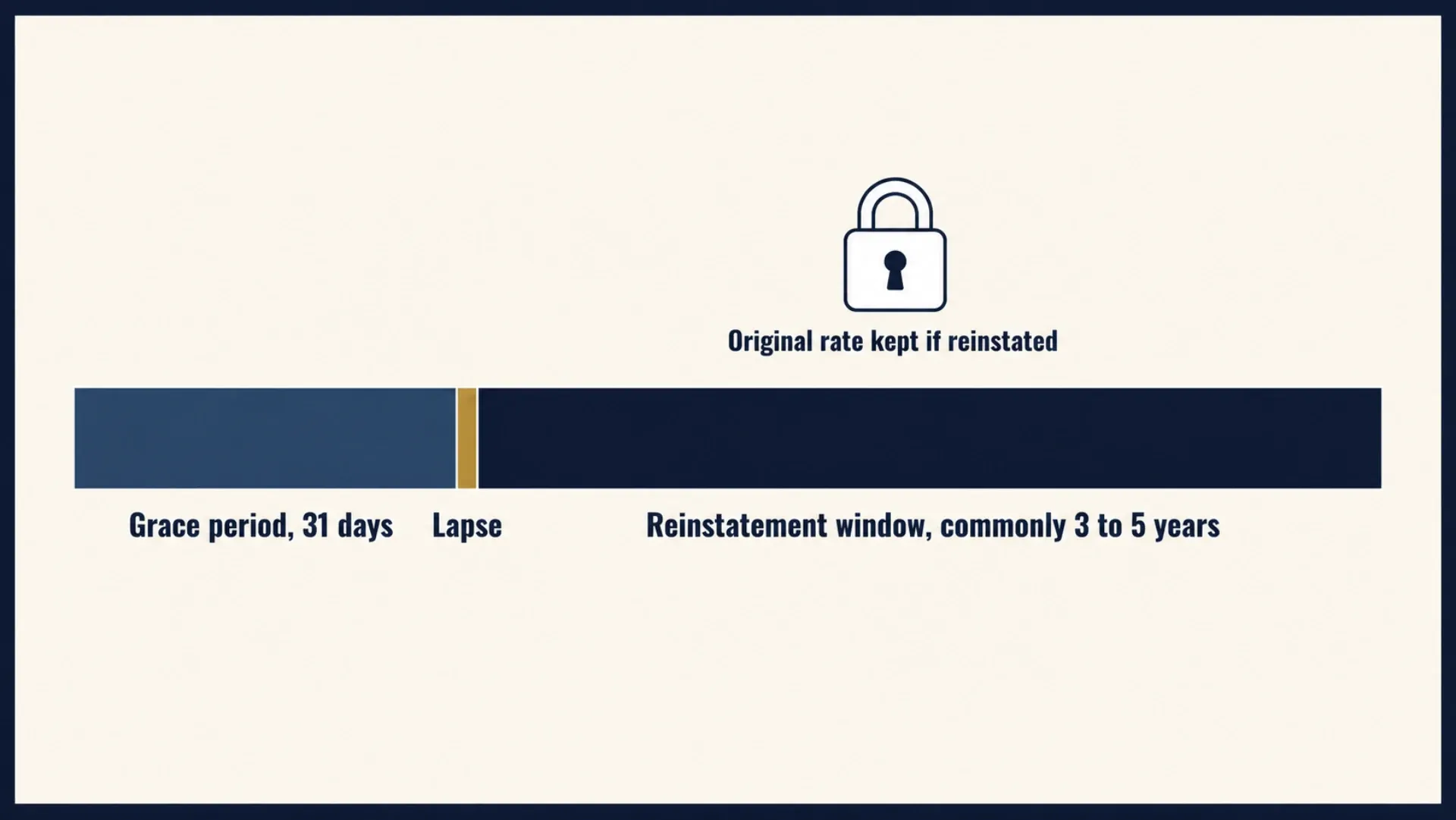
State law in every state requires a minimum grace period on life insurance, and the standard policy language gives you 31 days after the due date to pay. Some policies give 30, and some permanent policies give 60. During that window the policy is fully in force. If you die on day 20, the insurer pays the death benefit and deducts the overdue premium from it.
Two habits protect you here. Put premiums on automatic draft from an account that does not run dry. And open every envelope from the insurer, because the lapse notice arrives before the lapse.
What a life insurance policy lapse actually costs
When the grace period ends with the premium unpaid, the policy lapses. For a term policy that means coverage stops. Nothing is owed back to you, because term has no cash value, and nothing is owed to your family if you die after the lapse date.
A permanent policy with cash value may keep itself alive for a while. The insurer borrows the premium from the cash value (an automatic premium loan) or converts the policy to a smaller paid-up amount. That buys time, but it is spending your own money, and it ends when the cash value does.
The cost of a lapse is not the missed premium. It is the underwriting you already passed. Your rate was set at the age and health you had when the policy was issued. Buying again means new underwriting at your current age and current health, which is the subject of what waiting costs: how age changes a veteran's rate.
Life insurance reinstatement: reviving the same policy
Most policies let you reinstate after a lapse, commonly for three to five years from the lapse date. The requirements are the same nearly everywhere:
A reinstatement application
Evidence of insurability, which can be a short health statement for a recent lapse or a full exam for an older one
All overdue premiums, usually with interest
The reward for doing this is real. A reinstated policy keeps its original issue age and original rate class. If you were 34 and Preferred when it was issued, you are still 34 and Preferred for pricing purposes, even if you are 39 now.
Two cautions. First, reinstatement usually restarts the two-year contestability period, so the insurer can review the reinstatement application for misstatements if you die within two years of reviving the policy. Second, if your health has changed since issue, the insurer can decline reinstatement. It does not have to take you back.
If the lapse was days or weeks ago, call the insurer before you do anything else. Many will accept a late payment with a simple statement of health and skip the formal application.
VGLI: how a lapse works in the VA program
VGLI renews automatically as long as premiums are current. If it lapses for nonpayment, you can apply to reinstate with form SGLV 180, and the terms depend on timing:
Lapsed less than 6 months ago, and your health has not changed: you complete a short section stating that, with no health questions.
Lapsed more than 6 months ago, or your health has changed: you answer health questions and the reinstatement can be reviewed.
The amount due to reinstate is three times your monthly premium, at your current age. That is a small number next to what a lapse costs, so if you have missed a VGLI payment, do it now. The VA pages do not state a grace period length, so call the Office of Servicemembers' Group Life Insurance at 1-800-419-1473 before your next due date if you are unsure of your status. Notes on the premium schedule are on how to manage VGLI premiums as you age.
Reinstate or replace? How to decide
Run three checks.
How old is the lapse? Under a few months, reinstate. The insurer will likely make it easy, and you keep your original rate.
Has your health changed? If it has not, reinstating almost always wins, because you keep the underwriting you already passed. If it has, get quotes for a new policy before you apply for reinstatement, so you know both numbers. A reinstatement declined for health reasons goes on your record with the MIB exchange and can follow you to the next application. See declined or rated: what veterans should do next for how that record works.
Is the old policy still the right policy? A lapse is a natural moment to ask whether the term length and amount still fit. If your kids are grown and the mortgage is smaller, you may want less coverage for a shorter period, and a new policy at your current age can be cheaper than reinstating a large one. Use choosing your term length to reset the target, then compare.
Do not let a reinstated policy and a new policy overlap for long. Pay for one.
If a lapse is coming and you cannot stop it
Money gets tight. Before a policy lapses, call the insurer and ask about a reduced face amount, a change to a longer payment interval, or, on a permanent policy, using the cash value to carry premiums. On VGLI, you can reduce the coverage amount and the premium with a written request. A smaller policy that stays in force is worth more than a large one that lapses.
Frequently asked questions
How long is the life insurance grace period?
Most policies give 31 days after the due date, some 30, and some permanent policies 60. State law sets a minimum in every state. Coverage stays in force during the grace period, and a death during it is paid minus the overdue premium.
What a life insurance policy lapse actually costs?
After the grace period the policy lapses. A term policy stops paying anything. A permanent policy may keep itself in force for a time using its cash value, then lapse when that runs out.
Can I reinstate a life insurance policy lapse?
Usually, within a window set by the policy, commonly three to five years. You apply, show evidence of insurability, and pay the overdue premiums with interest. A reinstated policy keeps its original issue age and rate class.
How do I reinstate VGLI after it lapses?
File form SGLV 180 with OSGLI. A lapse under six months with no health change needs only a short statement; a longer lapse or a health change requires health questions. The reinstatement amount is three times your current monthly premium.
Is it better to reinstate or buy a new policy?
Reinstate if the lapse is recent and your health is unchanged, because you keep the original rate. Compare quotes first if your health has changed or your coverage needs have shrunk, since a smaller new policy at your current age can cost less.
Your next step
Get the free guide, "Leaving the Service: Your Life Insurance Decision Guide". It explains what your coverage is meant to do, which is the question to answer before you decide whether to revive it. Or take the quiz, Which Coverage Fits You?
Sources: NAIC, Model Laws, Regulations, Guidelines, standard policy provisions including the 31-day grace period (content.naic.org/sites/default/files/model-law-185.pdf); VA, SGLV 180, Application for Reinstatement of VGLI Coverage (benefits.va.gov/insurance/forms/SGLV-180.pdf); VA, Veterans' Group Life Insurance (va.gov/life-insurance/options-eligibility/vgli/); VA, VA Life Insurance Program Booklet, January 2024, VGLI renewal and reinstatement (benefits.va.gov/INSURANCE/docs/life-insurance-programs-booklet.pdf); MoneyGeek, What Is a Life Insurance Grace Period (moneygeek.com/insurance/life/life-insurance-grace-period/). Accessed September 2, 2026.