Life Insurance Settlement Options: Lump Sum, Installments, and Retained Asset Accounts

The claim form asks a question most people have never thought about: how do you want the money? The choices on that line are called life insurance settlement options, and the default one, a lump sum, is right for most families. This page explains each option, what it costs you, and the one choice that deserves a second look before you sign.
Start with the default: a lump sum
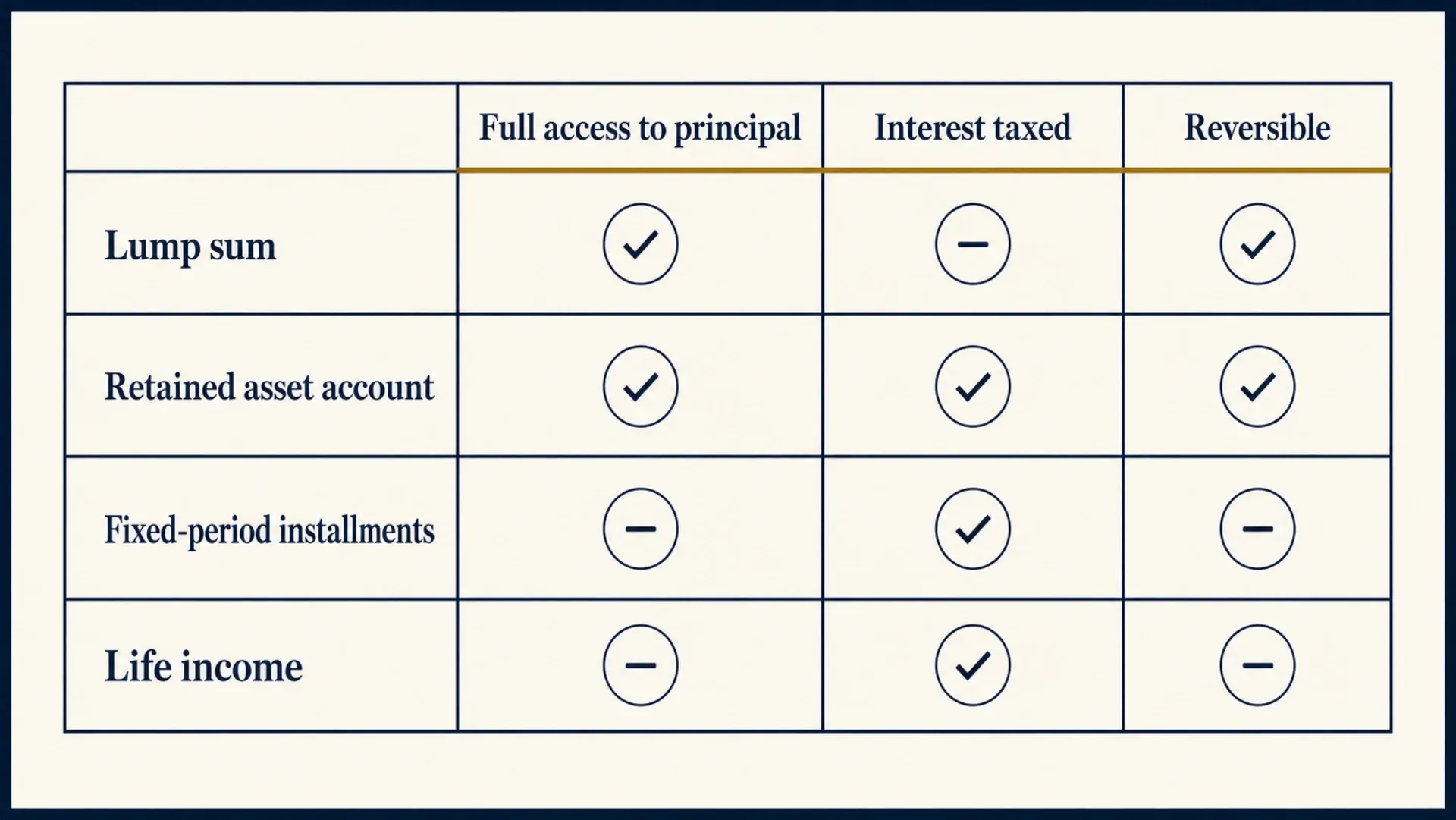
A lump sum pays the entire death benefit at once, by check or direct deposit. It is tax-free to you. Once it is in your account, it is yours to use, save, or invest however you decide.
For most beneficiaries this is the right answer, for a simple reason: it keeps every option open. You can pay off the mortgage, set aside a year of expenses, and put the rest with a financial planner. Nothing you choose later is blocked by the choice you made on the claim form.
The only real risk of a lump sum is spending it too fast in the first hard months. If that is a concern, the fix is a separate account and a waiting period you set for yourself, not a payout plan you cannot undo.
The retained asset account: read this before you check the box
Many insurers offer to place the lump sum in an account they hold, with a checkbook or draft book, and pay you interest until you take the money out. The VA programs call this the Alliance Account. The industry name is a retained asset account.
It looks like a bank account. It is not one, and the NAIC, which represents the state insurance regulators, has published consumer guidance on the differences.
Where the money sits. If the insurer keeps the funds itself, they are not FDIC insured. They are backed by the insurer and, if the insurer fails, by your state's guaranty association up to its limits. Some insurers place the funds with a bank, in which case FDIC coverage applies. Ask which.
The interest rate. The insurer sets it and can change it. Ask what the rate is, how it is set, and how it is credited.
Fees. Ask which services are free and which carry a charge.
Access. You can write one draft for the full balance at any time. The NAIC says so plainly, and it is the most important fact about these accounts: you are never locked in.
A retained asset account is a fine parking spot for a few weeks while you decide. It is a poor long-term home for a large sum, because a plain high-yield savings account at an FDIC-insured bank usually pays a comparable or better rate with stronger protection.
Installment options
If you would rather not receive one large sum, insurers offer several ways to spread it out. The names vary by company, but they fall into four types.
Fixed period. The benefit plus interest is paid in equal installments over a set number of years. The VA programs offer a version of this: 36 equal monthly payments.
Fixed amount. You choose the monthly payment and the insurer pays it until the benefit and interest run out.
Interest only. The insurer keeps the principal, pays you the interest, and pays the principal later, to you or to a contingent beneficiary. This was common when policies were sold decades ago and is rare as a fresh choice today.
Life income. The benefit buys an annuity that pays you for the rest of your life. Some versions guarantee a minimum number of years so the money is not lost if you die early.
Two things are true of every installment option. First, the interest portion of each payment is taxable income, while the principal portion is not. See are life insurance payouts taxable? Second, most installment elections are hard or impossible to reverse. A lump sum can become installments later by buying an annuity. Installments rarely become a lump sum.
Life insurance lump sum vs installments: how to decide
Ask three questions.
Can I manage a large sum? Be honest, and remember you do not have to manage it alone. A fee-only planner can set it up for a flat cost. If the answer is a firm no, a fixed-period option with a short term may fit.
Is anyone else counting on this money? If the benefit is meant to raise children, a lump sum in a properly titled account gives a guardian or trustee flexibility that installments do not.
What is the interest rate, really? Compare the insurer's installment rate to what an insured savings account or a Treasury bill pays today. If the insurer's rate is lower, the installment option is costing you money for the convenience.
For most veterans' families the answer is a lump sum by direct deposit, then a deliberate plan for it. A useful order: an emergency fund, then debts with the highest interest, then the long-term goals the policy was bought for. If you are not sure what the policy was meant to cover, how much life insurance do you need shows the math the insured probably used.
Choosing for SGLI and VGLI
The VA claim form, SGLV 8283, lists five choices: lump sum by check, lump sum by electronic transfer, lump sum into an Alliance Account, 36 monthly payments by check, or 36 monthly payments by electronic transfer. Everything above applies. If you want time to think, the Alliance Account gives it to you without locking anything in, and you can move the full balance to your own bank the same week. If you already know what you want to do, take the electronic lump sum. Our claim filing guide covers the rest of the VA process.
What happens if you never choose
If a beneficiary does not select an option, many insurers default to a retained asset account and mail the draft book. That is not a trap, but it is a decision made for you. Open the account statement, note the rate, and decide within the month whether the money should stay there.
Frequently asked questions
What are the life insurance settlement options?
Lump sum, a retained asset account (a lump sum held by the insurer with checkbook access), and installment options including fixed period, fixed amount, interest only, and life income. Most families choose a lump sum.
Is a retained asset account FDIC insured?
Not automatically. If the insurer holds the funds, they are backed by the insurer and the state guaranty association, not the FDIC. If the insurer places them with a bank, FDIC coverage applies. Ask the insurer which arrangement it uses.
Can I take my money out of a retained asset account at any time?
Yes. You can write a single draft for the full balance whenever you choose.
Are life insurance installment payments taxable?
The part of each payment that returns the death benefit is not taxable. The part that is interest is taxable income, and the insurer reports it to you.
What payout options does SGLI or VGLI offer?
A lump sum by check, electronic transfer, or Alliance Account, or 36 equal monthly payments by check or electronic transfer. The Alliance Account is a retained asset account with full access to the balance.
Your next step
Get the free guide, "Leaving the Service: Your Life Insurance Decision Guide". It covers what a policy is meant to do for your family, which is the question behind every payout choice. Or take the quiz, Which Coverage Fits You?
Sources: NAIC, Retained Asset Accounts and Life Insurance (content.naic.org/article/consumer-insight-retained-asset-accounts-and-life-insurance); NAIC, Retained Asset Accounts sample bulletin (content.naic.org/sites/default/files/inline-files/legal_bulletin_raa.pdf); VA, SGLV 8283 Claim for Death Benefits, payment options (benefits.va.gov/insurance/forms/sglv-8283-bene.pdf); IRS, Publication 525, life insurance proceeds paid in installments (irs.gov/publications/p525). Accessed September 2, 2026.